Home · Scythe, rake and baler
Museum wording and later machines
Scythe, rake and baler
The tools of haymaking have a museum record. They are not official Defra land-use categories, and they are not treated here as a substitute for the missing word “hay” in the 1 June 2026 notice.
The scythe
The Museum of English Rural Life’s page on a scythe says: “Scythes were used to manually cut crops or grass at harvest time. They replaced sickles and bagging hooks which required the user to repeatedly bend down low to cut the crops. Scythes themselves have now been largely been replaced – firstly by horse-drawn and more recently tractor machinery and then combine harvesters, but they are still used in some parts of Europe and Asia.” [source]
The same official page says the scythe “still remained in use even after the introduction of machines because the first machines, still needed the field to be opened up by clearing an area to give the mechanical mower room to start.” It was also “very useful for cutting in the awkward corners of a field that machinery could not access.” [source]
Using a scythe, the official page says, “is a skilled activity with the large, curved blade swung through the crop to cut it. An experienced reaper could reap up to 2 acres of wheat in a day.” That last official sentence is about wheat, and is left in that context. [source]
Wooden hay rakes
The MERL archive page for John George & Sons Ltd. says: “In 1911 the London firm of hardware factors, John George & Sons Ltd., decided to set up their own factory for the production of wooden hay rakes, scythe sneaths and other wooden items, in place of their previous practice of buying in such goods from a variety of local makers.” The same official page says a local maker, A.G. Last, “persuaded Stanley George to take over his business and build such a factory at Welnetham, near Bury St. Edmunds,” and that “The Welnetham works of John George & Sons Ltd. were opened in 1912.” [source]
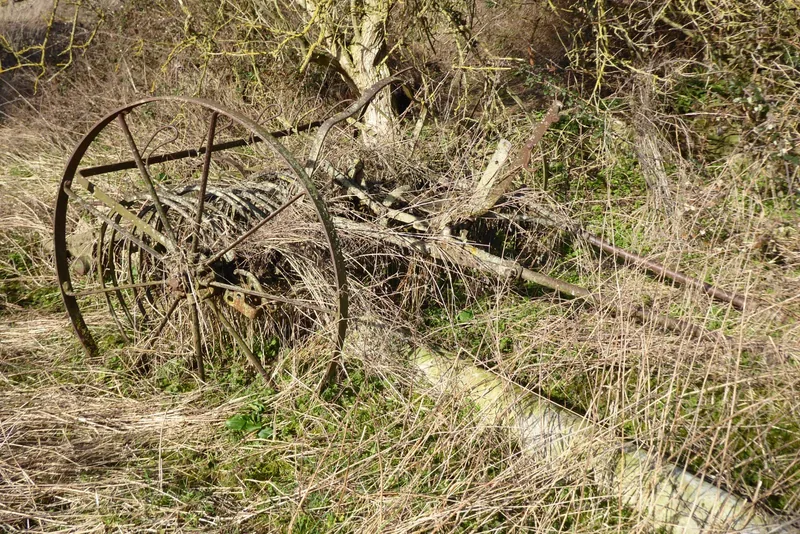
The dump hay rake in the photograph is an old implement beside a footpath, taken in February, not a factory record and not a June Survey category.
The baler
This site did not find an official MERL object page for a hay baler to quote in the same way as the scythe page. The photographs below are therefore captioned from their file and Geograph pages, and are not presented as museum catalogue wording.
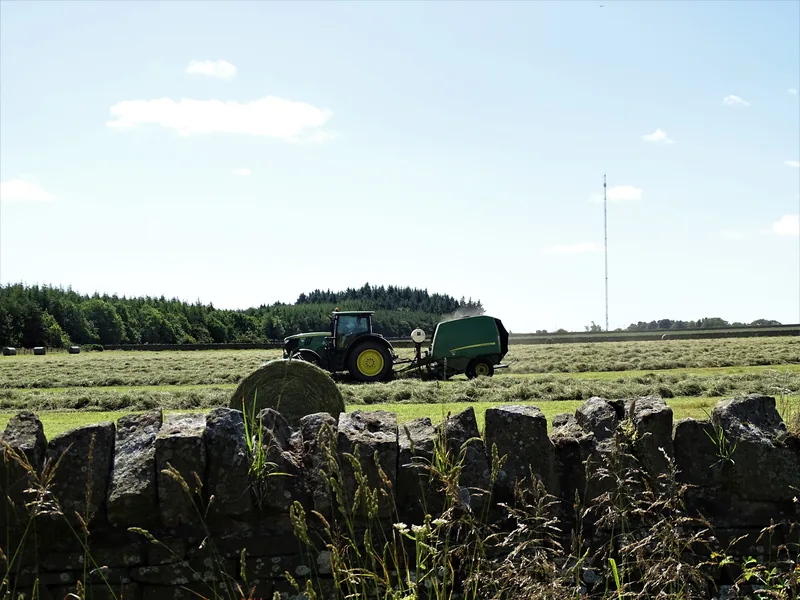
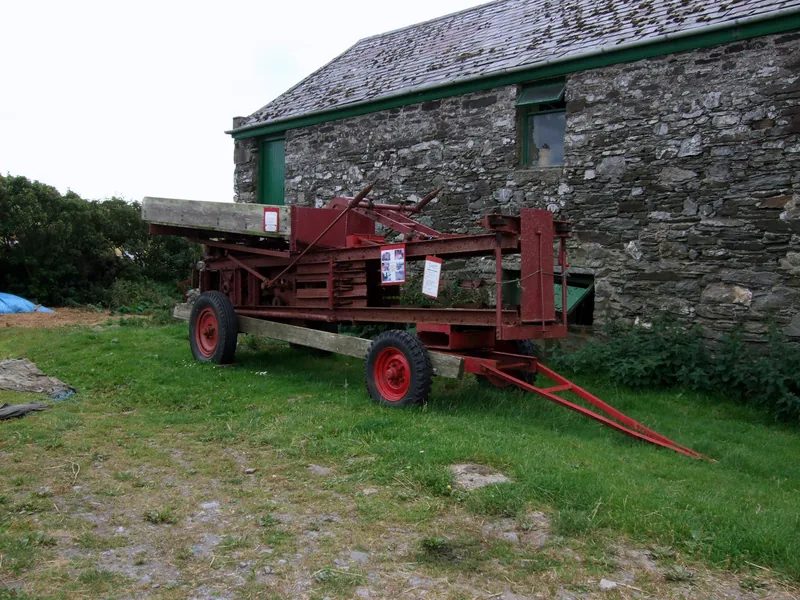
The Cregneash photograph is a museum exhibit. The Geograph page names it a 1947 Ross Stationary Self-feed Hay and Straw Baler at the Cregneash Folk Museum. That is a preserved machine on display, not a typical working day, and not an official land-use figure.
Enjoyed the hayfield?
No pop-ups. No intrusive advertising. Just interesting stuff. A little support helps the next farmyard site get built.