The Country Year
June was haymaking — and then the murals vanished
In the Country Pavilion of the 1951 Festival of Britain, haymaking had a month of its own, painted on a merry-go-round. The full-size pictures later went to a new museum, were shown at a royal agricultural show, and have not been seen since.
The Museum of English Rural Life holds five preparatory artworks by Barry Evans and William Kempster, objects 2019/3–7, designed in 1951 for a series called The Country Year. The series “was reproduced at a larger scale in a ‘merry-go-round’ structure” that sat between exhibits on Country Life and Rural Crafts. The carousel, a later essay records, “turned on an electric mechanism.” [source] [source]
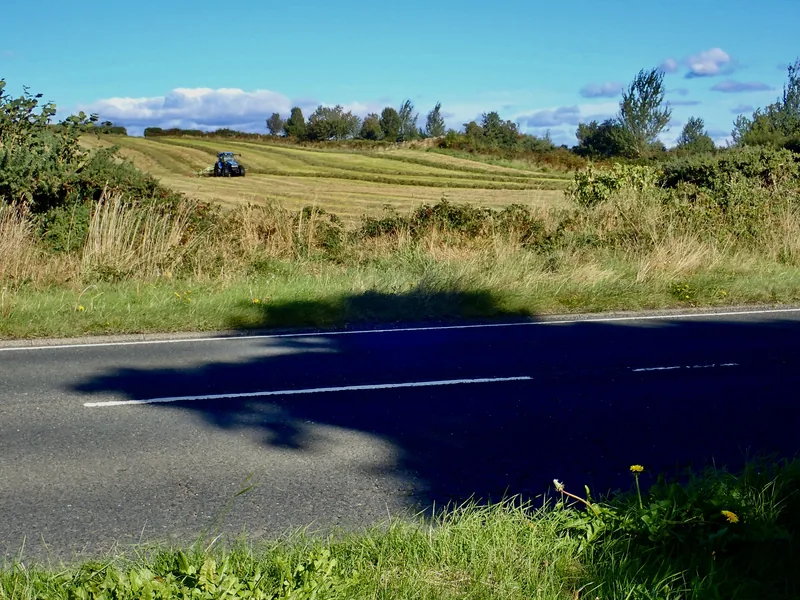
There were twelve panels, one for each month: hurdle-making in January, cultivating in February, lambing in March, stock-rearing in April, marketing in May, haymaking in June, village cricket in July, harvesting in August, a Young Farmers rally in September, potato-lifting in October, ploughing in November, and field sports in December. The five designs that survive are for lambing, haymaking, harvesting, potato-lifting and ploughing. Evans (1923–2007) and Kempster (1914–1977) also made work for the Dome of Discovery. [source] [source]
Evans later remembered that, although the two of them usually did their own research, “for the Farming pavilion, there was a theme convener called Laurie Lee, the writer. He was a few years older than me, probably in his thirties, a delightful person to work with.” That is Evans’s recollection, written down in Dr Naomi Lebens’s 51 Voices essay. [source]
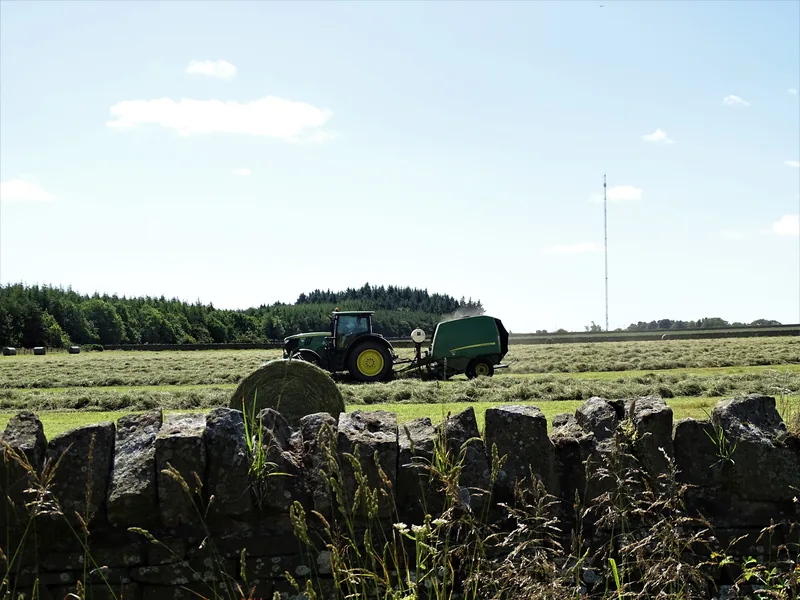
A contemporary reviewer, writing in The Engineer in 1951 (volume 191, page 671), noticed something missing. The panels of ploughing, cultivating, haymaking, corn harvesting and potato lifting, the review said, “all show the impact of mechanisation on agriculture. There is, however, no reference to the combine-harvester, which is by now extensively employed in this country.” The harvesting sketch that survives at the Museum, object 2019/5, shows what was painted instead: “tractors, reapers, a threshing machine, and a steam engine.” [source]
When the Festival came down, the displays were “broken up and sold or sent on to suitable venues.” The large Country Year artworks were among the things sent to the newly formed Museum of English Rural Life. They were “put immediately to work in the Museum’s trade stand at the Royal Agricultural Show at Newton Abbot.” Lebens’s essay dates that show to 1952, and notes photographs of the murals hanging in the Museum’s open-air stand. A photograph of the stand even shows, behind a telephone, the lost September panel of a Young Farmer’s Rally. [source] [source]
And then they disappear. “They were subsequently lost and their whereabouts remains unknown.” The murals do not appear to have been accessioned as Museum objects. “No trace of them has since been found.” What the Museum has now are the cartoon designs, “given to the Museum a few years ago,” and, more precisely, five mural designs given by the estate of Barry Evans in 2019. They are, the object page says, “a tantalizing glimpse of what the lost set were like.” June’s haymaking is one of the glimpses. [source] [source]
Keep exploring
Enjoyed the haymaking?
No pop-ups. No intrusive advertising. Just interesting stuff. A little support helps the next farmyard site get built.