History
From a blade that opened the field to a baler in the lane
Hay is grass, cut and dried while the weather holds. The tools changed; the hurry did not. A scythe replaced the stooping sickle, then stayed on to open the field for the first machines. Wooden rakes were made in a Suffolk wood. Later a baler followed the tractor down the swath.
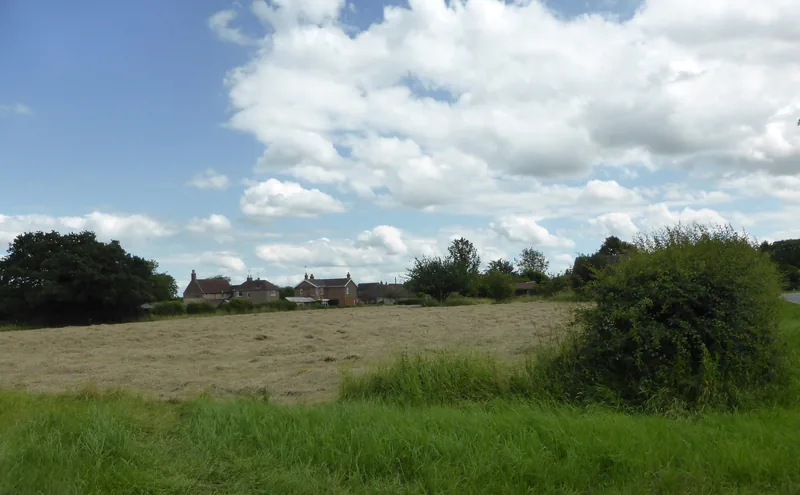
The Museum of English Rural Life puts the scythe’s place in the sequence cleanly. Scythes cut crops or grass at harvest. They replaced sickles and bagging hooks, “which required the user to repeatedly bend down low to cut the crops.” Later they were themselves largely replaced — first by horse-drawn machines, then by tractor machinery and combine harvesters — “but they are still used in some parts of Europe and Asia.” The scythe did not vanish on the day the first mower arrived. [source]
It stayed because “the first machines, still needed the field to be opened up by clearing an area to give the mechanical mower room to start.” It also remained useful “for cutting in the awkward corners of a field that machinery could not access.” An experienced reaper “could reap up to 2 acres of wheat in a day,” and carried a whetstone because the blade had to be kept very sharp. [source]
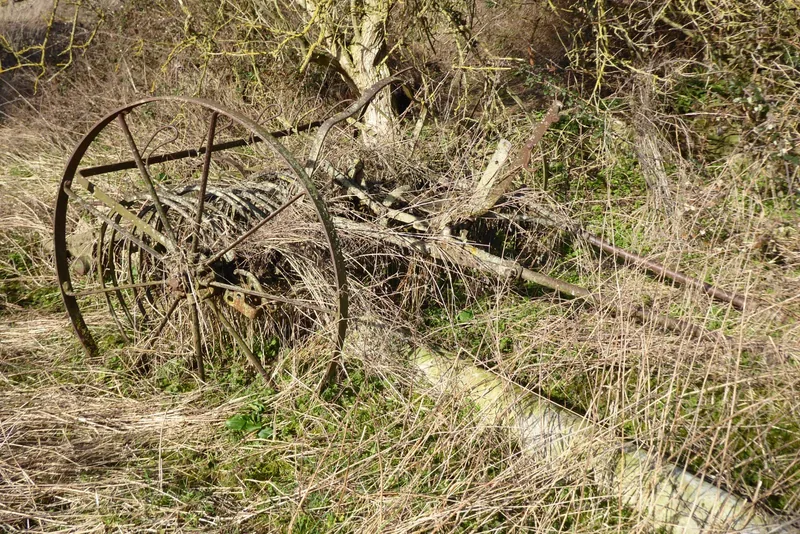
Behind those hand tools sat a surprising amount of manufacture. In 1911 John George & Sons, London hardware factors, decided to make their own wooden hay rakes and scythe sneaths. A. G. Last persuaded Stanley George to take over his business and build a factory at Welnetham, opened in 1912, with timber from Felsham Hall Woods. Some simpler goods were made in the open. A works fire in 1939 destroyed many early records. The woodland later became Bradfield Hall Nature Reserve. [source]
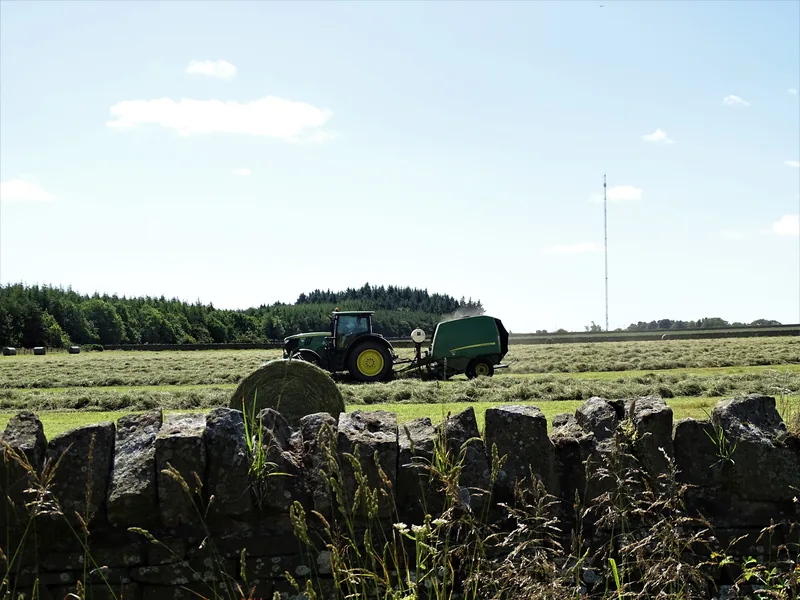
By the time Robert Graham photographed a hay baler at work near Maiden Law, with the former Burnhope television mast in the distance, on 16 July 2021, the loose hay of the rake and the cock had largely given way to bales. A much older fixed machine, a 1947 Ross stationary self-feed hay and straw baler, still stands at Cregneash Folk Museum. The official land-use map, meanwhile, will tell you how much of England is farmed, and how much of that can be cropped — including temporary grass — but it will not hand you a neat official total for hay. At 1 June 2026 the croppable area was 55.7% of utilised agricultural area, “whilst permanent grassland accounts for an additional 39.5%.” Hay lives somewhere in that grass, still unnamed as a total of its own. [source]
In 1951, haymaking was important enough to be given a month of its own at the Festival of Britain. Barry Evans and William Kempster’s twelve-panel carousel, The Country Year, sat in the Country Pavilion between exhibits on Country Life and Rural Crafts. June was haymaking; August was harvesting; November was ploughing. The finished murals later travelled to the new Museum of English Rural Life and were shown at the Royal Agricultural Show at Newton Abbot in 1952. After that they vanish from the record. Five preparatory designs, given by Barry Evans’s estate in 2019, are what remain — including the haymaking scene. [source] [source]
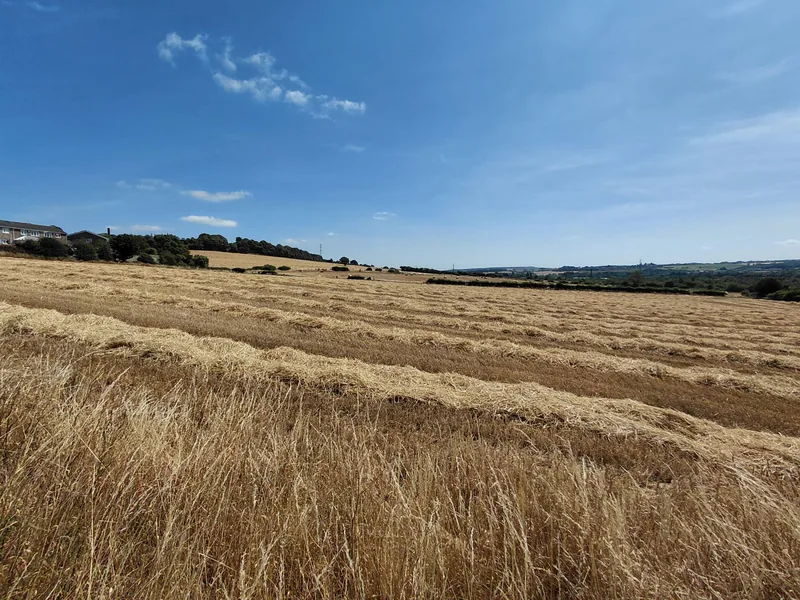
The wooden rakes in those fields had more than one home. While John George & Sons were building a factory in a Suffolk wood, Harry J. Wells was at work on Bucklebury Common in Berkshire. He was a handle maker from Heatherdene, and his workshop stood on the common for forty years, until he retired in 1950. Bucklebury Common, the Museum says, “was a great centre of woodland crafts,” with bowl-turners, rake-makers and beesom-makers using timber grown there. Wells made wooden rakes, scythe handles, stable fork handles, and a good many other handles besides. One hundred and four of his tools and pieces of equipment, dating from 1910 to 1950, are in the Museum now. [source]
Enjoyed the haymaking?
No pop-ups. No intrusive advertising. Just interesting stuff. A little support helps the next farmyard site get built.