Welnetham
The rakes came from a factory in a wood
John George & Sons were not, at first, country manufacturers. They were a London firm of hardware factors. In 1911 they decided to make their own wooden hay rakes, scythe sneaths and other wooden items, “in place of their previous practice of buying in such goods from a variety of local makers.”
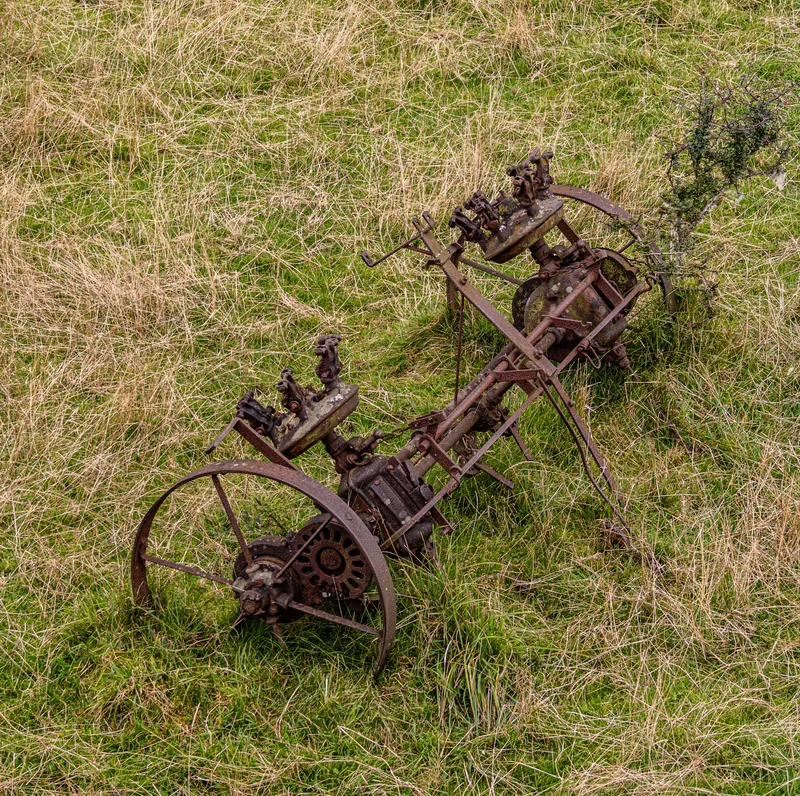
The turn into manufacture had a very local nudge. “It was a local maker, A.G.Last, who persuaded Stanley George to take over his business and build such a factory at Welnetham, near Bury St. Edmunds.” The Welnetham works opened in 1912. Coppice woods about a mile away, in Felsham Hall Woods, were leased “to provide a continuous supply of timber, mostly ash, birch, alder, hazel and willow.” [source]
Rakes and sneaths were only the start. The firm also produced “beetles, sheep hurdles, stable forks and all manner of handles and pegs.” Not everything was made under a roof: “certain simpler types of product were made in the open.” In 1934, growth led to the purchase of some 300 acres of coppice in those same woods. [source]
Then came the fire. In 1939 a works fire “not only caused the rebuilding of the works, including the installation of a Blackstone diesel engine to drive the plant, but also unfortunately the destruction of many early records.” Anyone trying to write the firm’s early history is already walking through that smoke. [source]
By the 1960s, “a decline in trade had set in,” and John George & Sons placed their Welnetham operations in liquidation in 1967. In 1970 the business was purchased by the Litchfield family and traded as Welnetham Woodwork Ltd. At the same time, the woodland was purchased by the Society for the Preservation of Nature Reserves and became Bradfield Hall Nature Reserve. A factory that had lived off a wood left a reserve behind it. [source]
The concern changed hands again in 1974, when it became the property of Ron Hack, a freelance journalist, and finally in 1984, when Neville Graydon, a furniture designer and maker, bought the firm and deposited the archives of the Welnetham business with The MERL. The records cover 1913 to 1982: factory, legal, accounts, production, stock, dispatch, correspondence, sales, and records relating to the woods. [source]
Enjoyed the haymaking?
No pop-ups. No intrusive advertising. Just interesting stuff. A little support helps the next farmyard site get built.