The swath desk
Open a drawer
A factory in a wood, a fire and a nature reserve, a scythe that opened the field, a probable rasp, a 1947 baler at Cregneash, a proverb in 2026, and what the official map does and does not say.
Open a drawer to look closer at haymaking: a rake factory raised in a Suffolk wood, a scythe that still had to open the field for the first machines, a blacksmith who probably turned farrier’s rasps into a blade, a 1947 baler on the Isle of Man, and a photographer who, in 2026, could not resist the old proverb.
London hardware factors, and a Suffolk wood
In 1911 the London firm of hardware factors, John George & Sons Ltd, decided to make their own wooden hay rakes, scythe sneaths and other wooden items, instead of buying them in from local makers. It was a local maker, A. G. Last, who persuaded Stanley George to take over his business and build a factory at Welnetham, near Bury St Edmunds. The works opened in 1912. Coppice about a mile away in Felsham Hall Woods was leased for timber — mostly ash, birch, alder, hazel and willow. The firm also made beetles, sheep hurdles, stable forks, handles and pegs, and some simpler goods were made in the open. [source]
A fire in 1939, and a wood that became a reserve
In 1934 the firm bought some 300 acres of coppice in Felsham Hall Woods. A works fire in 1939 led to the rebuilding of the works, including a Blackstone diesel engine to drive the plant, and to “the destruction of many early records.” Trade declined; the Welnetham operations went into liquidation in 1967. In 1970 the Litchfield family bought the business, which then traded as Welnetham Woodwork Ltd. At the same time, the firm’s woodland was purchased by the Society for the Preservation of Nature Reserves and became Bradfield Hall Nature Reserve. The firm later passed to Ron Hack in 1974, and in 1984 to Neville Graydon, a furniture designer, who deposited the archives — covering 1913 to 1982 — with The MERL. [source]
The first machines still needed a scythe
Scythes were used to cut crops or grass at harvest. They replaced sickles and bagging hooks, “which required the user to repeatedly bend down low to cut the crops.” Later they were themselves largely replaced, first by horse-drawn machines, then by tractor machinery and combine harvesters. But they stayed in use, the Museum says, “because the first machines, still needed the field to be opened up by clearing an area to give the mechanical mower room to start.” They were also useful in awkward corners a machine could not reach. An experienced reaper “could reap up to 2 acres of wheat in a day.” [source]
Probably made from a farrier’s rasp
The MERL’s scythe, object 96/88, dates from around 1900. It was given by Mrs Monger, from tools that had belonged to her father, George Ernest Brown, and her grandfather, Charles Lesley Brown, “a well-known family of shop keepers in Bramley, Hampshire.” The 1911 census shows their occupation as “grocer and farmer.” “This scythe was probably made by the village blacksmith Alfred Willis.” He had a reputation for taking old farrier’s rasps and turning them into edged tools, and was “described as the last manufacturer of hand-forged agricultural edge tools in central Southern England.” The official word is probably, and this site keeps it. The note was written by MERL volunteer John. [source]
A 1947 Ross baler, at Cregneash
On 2 September 2011, Richard Hoare photographed a Ross hay and straw baler at Cregneash Folk Museum. The Geograph page describes it as “A 1947 Ross Stationary Self-feed Hay and Straw Baler at the Cregneash Folk Museum.” It is a museum machine, not a picture of a typical working day, and a reminder that hay and straw were once packed in a fixed place as well as in the field.
The photographer could not resist the proverb
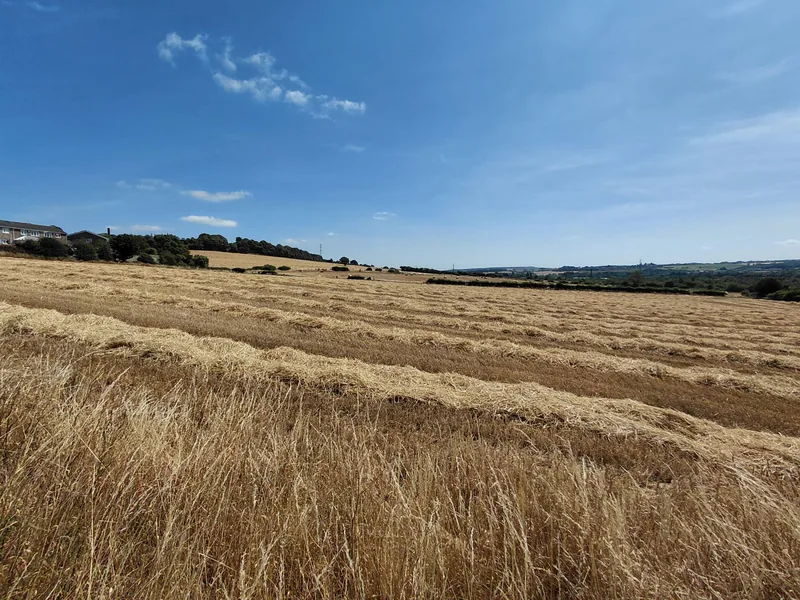
On 24 July 2026, Stephen Craven photographed late-July haymaking at Healey, in the City of Wakefield. The Geograph page says: “The very dry summer of 2026 gave plenty of opportunity to ‘make hay while the sun shines.’” That is the photographer’s wording, not an official weather record, and it is all the better for being said of a real field, on a named day.
England’s official farmed map, not a hay total
Defra’s June Survey of agricultural land use in England, at 1 June 2026, puts the utilised agricultural area at 8.8 million hectares, 67.7% of the area of England. The croppable area was 4.9 million hectares, 55.7% of that utilised area, and includes temporary grassland as well as cereals and other crops. The notice does not publish a separate official total for land cut for hay, or a hay tonnage, and this site does not invent one. [source]
Keep exploring
Enjoyed the haymaking?
No pop-ups. No intrusive advertising. Just interesting stuff. A little support helps the next farmyard site get built.